High Precision Clock Sources
GPS/GNSS Receiver (HW Option)
The optional high-sensitivity GPS/GNSS modules (built-in) provide accurate Phase alignment and Coordinated Universal Time (UTC) synchronization to the test set, in the form of internal pulse-per-second (1PPS) clock synchronized to the standard second and timestamps. This is used to assure that two or more geographically-distributed test sets have the exact same time and can calculate delays. One example is the One-Way-Delay (Latency) tests used to identify asymmetry between each direction of a link.
The GPS Time of Day (ToD) can also be used to precisely set the local date and time in the test set, using the Sync ToD function, which will apply the local time zone correction before applying it to the test set system real time clock. This timestamp is used for reports and events, but not for time-sensitive testing.
GPS ToD is also used in One-Way-Delay (OWD) measurements and time is applied directly to each test set before the test starts, so they all have accurate time.
The GPS/GNSS receivers can be turned OFF if not used, to save battery power.
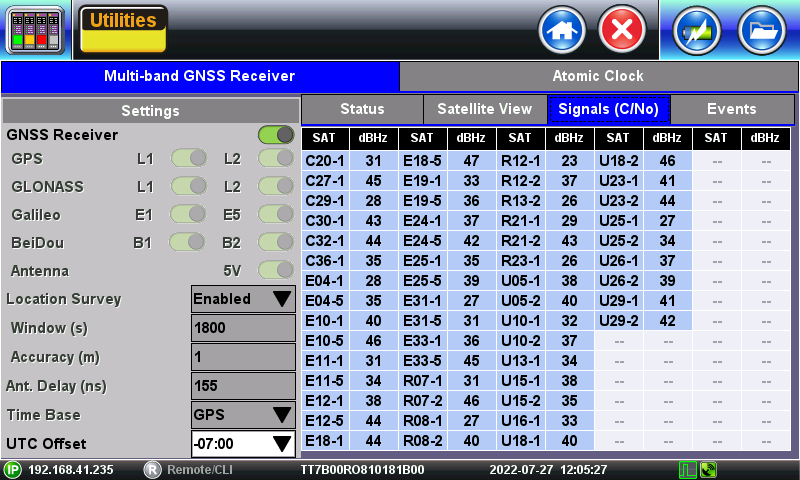
A satellite table, showing satellites in view, satellites being used and signal to noise density, is provided for information only, so the correct antenna installation can be verified. Geographical coordinates are also provided for information only and it could be used in the future to geo-tag some position-sensitive results. The GPS/GNSS antenna must have direct view to the sky. At least four satellites with SNR of 34 dB-Hz or better are recommended for accurate testing.
Warm Up Times
All precision reference sources require a “warm up” time to achieve high accuracy and stability. The warm up term is being used loosely because it is not just about attaining the right temperature. It also includes disciplining of a local oscillator, negotiating and stabilizing a clock through protocol messages, etc. Each of the tasks involved takes time to stabilize before it can be used for testing.
Operational Temperature
It is still a major player in the warm-up waiting time and it all depends on the ambient temperature and the initial temperature of the test set. For example, a test set left in the trunk of a car in a winter night will take longer to reach operational temperature.
GPS Lock
The time to get an stable clock output varies depending on the conditions, antenna type and installation, sky visibility and whether or not the test set has changed position. Using the test set for the first time on a new site (different geographical position) would increment the time to its first satellite lock. Users can follow the different stages (Searching, Sync 1PPS, and Lock) by checking the GPS status GUI at >Utilities >Settings >More >High Precision Clock Source >GPS.